Enquire About This Tour Code LLR Altiplano
Duration: 46 Days Route: Lima to Rio de Janeiro Style: Overland Tours Price: US$4,569.00
Peru, Bolivia, Argentina, Paraguay, Brazil
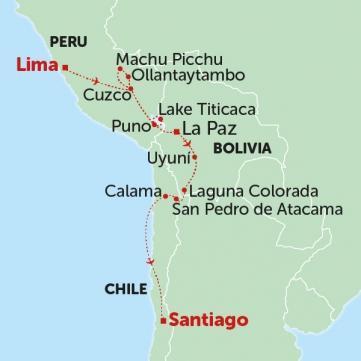
This tour offers you the journey of a lifetime. From the Pacific to the Atlantic Ocean, across the heart of South America, encompassing all forms of terrain and most of the major sights that this amazing continent has to offer.
The tour that we operate in the reverse direction is Altiplano (LRL).
Tour Dossier Introduction
- Dossier Last Updated: 10-04-2013
- Tour Code: LLR
- Duration: 45 nights / 46 days
- Joining City: Lima
- Departure City: Rio de Janeiro
- Nearest Joining International Airport: Jorge Chavez International Airport Lima (LIM)
- Nearest Departing International Airport: Galeao Antonio Carlos Jobim Intl Apt Rio (GIG)
This dossier is designed for this particular tour and should be read in conjunction with the country dossier(s), regional pre-departure booklet and optional excursions guides relevant to your itinerary. You will also receive a joining letter in advance of your journey with further information, while last minute updates may be posted in the Latest News section of our website.
Tour Documents
PDF Document
Web Page
Inclusions
- Accommodation: 23 night(s) in hotel(s), hostel(s) & guesthouse(s), 17 night(s) camping, 2 night(s) in homestay(s), 3 night(s) in hotels or campsites on the trek route
- Meals: 24 breakfast(s), 33 lunch(es), 23 dinner(s)
- Excursions: Ballestas Islands, Huacachina Oasis, Chauchilla Cemetery, Puerto Inca, Colca Canyon, Sacred Valley, Inca Trail Trek, Machu Picchu, Lake Titicaca, Salar de Uyuní, Trinidad ruins, Iguazú Falls – Argentina, Iguazú Falls – Brazil, Bird Park
- Transport: Tucan Travel vehicle, train, boat, taxi, on foot, 4WD
- Age: 18-60, max. 65 (recommended)
- Group: Average 15-24
- Staff: Tucan Travel tour leader, Tucan Travel driver, local guides
Exclusions
Sleeping bag & sleeping mat
International flights and departure taxes
Domestic flight taxes if applicable
Tips on included excursions, visas, travel insurance, personal items and single rooms.
Airport transfers and pre and post tour accommodation
Spending money – budget for meals, snacks, drinks, limited souvenirs, laundry, tips and any extras
Optional excursions - Please see our optional excursions guide on the dossier page for a comprehensive list of optional activities and excursions available on this tour.
Highlights
-
Nazca Lines
-
La Paz
-
Uyuni Salt Flats
-
Iguazu Falls
-
Rio de Janeiro
Detailed Itinerary
Day 1 to 1 - Arrive Lima
The first day of your tour is simply an arrival day with no pre-organised activities. In order to allow time to relax and see some of the sights you may wish to add pre tour accommodation. On arrival please ask at the reception for information on when the pre departure meeting will be held.
Lima was founded by Francisco Pizarro in 1535 and called La Ciudad de Los Reyes (City of the Kings). It was the capital of the Spanish conquistadors until its independence in the early 19th century. Here you will find some of the finest museums in South America, such as the Gold Museum and the Museum of the Inquisition, to name but a few (optional). Our hotel is in close proximity to the main Plaza de Armas, where you'll discover fine old buildings with intricately carved wooden balconies and ceilings, a marvellous place for the culture vultures among us. The Government Palace facing the Plaza de Armas is beautifully built in white marble, as is La Cathedral, built in 1555, which also faces this square. You'll see an elegant bronze fountain at the centre of the square and standing tall behind the palace is the Cerro San Christobal Mountain, which offers great views of the city and the sea. San Francisco Monastery is a must see with its splendid interior, fine and detailed mosaics covering the walls, and the stunningly macabre catacombs with their thousands of bones - this display is certainly not for the faint hearted! With an estimated population of 8 million inhabitants, Lima is a melting pot of Peruvians, so you'll see a good cross section of the population. Lima has an array of churches, markets and other grand plazas plus an assortment of modern suburbs to visit.
Day 2 to 5 - Pisco – Nazca – Puerto Inca
Continuing south we arrive at Pisco. Peru's national drink, the 'pisco sour', was named after this town. We spend the night in Pisco where you will have the opportunity to try some wonderful local seafood and perhaps sample one (or two) of the finest pisco sours to be found in Peru. In neighbouring Paracas, we will travel by boat to the Ballestas Islands the following morning - sometimes known as the 'poor man's Galapagos' because of the excellent opportunities to view wildlife such as boobies, pelicans and penguins so near to the mainland. The trip takes us past the giant "Candelabra" figure etched onto the side of a mountain. After our visit to the colonies of seabirds and sea lions basking on the rocks we'll head deep into the desert towards the stunning Huacachina oasis where you have the chance to try your hand 'sandboarding' or take an exhilarating ride in a dune buggy down the enormous dunes. The brave can go for a dip in the murky lagoon, which is said to have therapeutic properties.
Nazca, an oasis town, is renowned for its mysterious parallel lines and geometrical figures etched onto the desert floor. Although there is a viewing tower, these giant designs can only be fully appreciated from the air. You can take a fascinating flight (optional) over the enormous lines and shapes, which include a monkey, hummingbird, condor, spider and even a spaceman. The designs are thought to have been made by three different groups of people: the Paracas (900-200 BC), the Nazca (200BC-600AD) and then new migrants from Ayacucho around 630AD. Other attractions around Nazca include watching workers extracting gold and a visit to ceramic workshops where you will receive a demonstration of their art.
On our way out of town, towards Puerto Inca, we visit the incredible Chauchilla Cemetery. The sites have been excavated so you can see ancient mummies with their hair and even skin still intact. We travel along the rugged coastline to Puerto Inca, the Inca port which connected the coast with the ancient city of Cuzco up in the mountains. Just five minutes walk away are the preserved ruins, which once stored sea produce to be traded with wares brought down from the Andes. In Inca times, messages and fresh sea fish were sent 240 kilometres to Cuzco using a series of relay runners each doing seven kilometres, taking 24 hours to complete the journey.
Day 6 to 10 - Arequipa – Colca Canyon – Cuzco
We wind our way into the foothills of the Andes and the stunning colonial city of Arequipa, overlooked by the massive volcano "El Misti". This city has some of the best examples of colonial architecture and the main plaza is quite magnificent, decorated with archways and dominated by the splendid cathedral, which was completed in 1612. Although an earthquake in 2001 damaged the cathedral, it has not diminished any of the splendour of this charming square. One of the 'must see' attractions here is the vast Santa Catalina Convent (optional), a maze of cobbled streets, cloisters and other decorative buildings, it has only been open to the public since 1970 and it is certainly well worth the visit.
Another popular attraction is the acclaimed 'Museo Santary', which highlights well preserved mummies including the famous 'Ice Princess Juanita' - a young Inca maiden who was sacrificed some 500 years ago atop the Nevado Ampato volcano. You can enjoy a free day in Arequipa to explore these sights and more, at your own leisure.
Our next destination is the Colca Canyon, one of the deepest in the world. The drive takes us through a high Andean desert, with amazing scenery all the way. We pass ghost towns destroyed by earthquakes and with luck we will see a condor or two soaring out of the canyon from our vantage point, 1,200 metres above the canyon floor. In the evening we have time to soak in the thermal springs near Chivay, where we spend the night.
The oldest continuously inhabited city in South America, Cuzco was the hub of the Inca Empire and features a population of around 300,000, most of who are indigenous. This marvellous colonial city is situated 3,310 metres above sea level and has numerous churches, some of which were built using recycled Inca masonry, as were many other buildings in Cuzco. The main square is called the Plaza de Armas, which has the beautiful cathedral on one side, which took a century to build, and the Church of La Compañia de Jesus on the other. The colonial arcades, which occupy the remainder of the plaza, are full of restaurants and shops. Enjoy a cup of coca tea at one of the local cafés and take time to acclimatise to the altitude. There are also many fascinating markets in Cuzco, the most well-known being San Pedro where all kinds of textiles and artisan merchandise are sold. Enjoy wandering the streets, visit the many markets and soak up the friendly atmosphere. If you're in the mood for a cultural experience, take a peek inside the 14th-century Inca palace which was later converted into the city's Museo de Arte Religioso (Museum of Religious Art). Well worth exploring during your time here is the ancient archaeological site of Sacsayhuaman, which has the largest and most impressive Inca stonework of all. It is also well worth your time to visit some of the nearby Inca ruins: Kenko, Tambomachay and Puka Pukara.
For tours in Cuzco before 1st February 2013, passengers will enjoy the Inca Trail two days earlier.
Day 11 to 15 - Ollantaytambo – Inca Trail Trek
On our full day excursion to the Sacred Valley of the Incas we will visit the isolated Pisac ruins perched on a hill high in the mountains and visit the famous local market of the same name in the valley below. This is a great place to buy textiles, pottery and jewellery and a great place to admire the fantastic view. After some time at both the ruins and the markets, we move down the valley to the temple fortress of Ollantaytambo, with its enormous terraces climbing up the hillside. For those trekking the Inca trail, you will spend the night here in Ollantaytambo for your early start in the morning.
For those who have chosen not to trek the trail, you will continue back to Cuzco where you will have some time to further explore Cuzco before your trip to Machu Picchu by train. There are plenty of other optional excursions available, including white water rafting down the Urubamba River, horse riding through native villages and Inca ruins.
Please see the brochure or the 'Useful Information' section of our website for important booking regulations and prices. You may not be able to complete the trek if you have not read this information. For more details about the trail facilities, equipment, preparation etc. please ask your agent for an 'Inca Trail Info Sheet'. If you are trekking the alternative Lares Trek you should ask for a 'Lares Trek Info Sheet'. Both documents are available to download from our website.
You will have a briefing to prepare for the trek by your local guide. They will cover ideal things to take, what the porters will assist you with and what you can expect from the trek each day. This briefing will take place during your initial days in Cuzco.
If you have chosen to hike the Inca Trail you will cross spectacular passes and visit more Inca ruins en route to the Lost City of the Incas, Machu Picchu. A local guide will lead this expedition and there will be cooks and porters to carry the main equipment, leaving you with just a small daypack. The trek begins after a short bus journey and the first day is a relatively easy four-and-a-half hour, 13-kilometre-walk, which will get you limbered up for the highest pass at Warmiwañusca (4,200 metres) which you will reach before lunchtime on the second day (Warmiwañusca translates as 'Dead Woman's Pass'). During the second day you will cover approximately nine kilometres in about five to seven hours and after the high pass it's all downhill as the trail winds its way down old Inca-built stairs to our campsite. On the third day we pass the ruins of Runkurakay, Sayacmarca and Phuyupatamarca, walking approximately 15 kilometres in seven hours. The last morning, after an overnight stop at Wiñay-Wayna, you will rise early for the final walk to Machu Picchu and greet daybreak over the famous "Sun Gate". There will then be time to explore on your own or simply take in the magnificence of the place after your guided tour.
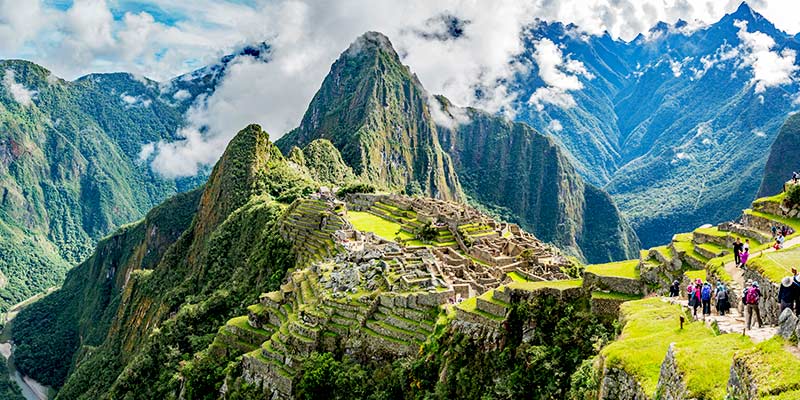
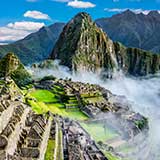
The Lost City of Machu Picchu was originally completely self-contained, surrounded by agricultural terraces sufficient to feed the population, and watered by natural springs. Located high above the fast flowing Urubamba River, the cloud shrouded ruins have palaces, baths, temples, storage rooms and some 150 houses, all in a remarkable state of preservation that will simply take your breath away.
The ruins were only uncovered by the outside world in 1911, when American explorer Hiram Bingham found them while looking for another 'lost city' called Vilcabamba. Due to their isolation many of the buildings are still relatively intact and you can't help but admire Huayna Picchu or 'Young Mountain' (Machu Picchu means 'Old Mountain'), which towers above the ruins. After spending most of the day at Machu Picchu you have the chance to soak your tired muscles in the hot springs at Aguas Calientes or meander through the markets before returning to Cuzco by train.
Day 16 to 20 - Cuzco – Puno – Lake Titicaca – Puno
After the Inca Trail (or free time) we have some more time in Cuzco where you can spend your time exploring this wonderful artistic town. Of course there is much to see during the daylight hours but once the sun goes down, the lights of Cuzco come up and around the plaza the nightlife is spectacular with bars, nightclubs and every type of restaurant imaginable.
We are now destined for the town of Puno, on the shores of Lake Titicaca. The journey takes us alongside majestic snow-capped mountains before reaching the La Raya pass at 4,321 metres. There is a research station, which studies high altitude animals such as llamas, alpacas and vicuñas. From Puno we visit the astounding floating reed Islands of the indigenous Uros people and experience their way of life. We will have the option to take a ride in a traditional reed boat made of totora plants, which also form a staple part of the local people's diet and medicine. We then make our way to Amantani Island to spend the night in the homes of local families. This beautiful, traditional island is home to Aymara people and is situated in the centre of Lake Titicaca. The following morning we'll stopover at Taquile, where the men stand, knitting typical woollen hats, while the women tend the fields. We return to Puno in time to do more shopping, Puno is one of the best places to bargain for alpaca sweaters.
Day 21 to 27 - La Paz – Potosí – Uyuní
La Paz, at 3,636 metres above sea level is the highest capital city in the world. Just about every building is built on some sort of hill, so sightseeing will literally take your breath away! Our hotel is close to the fascinating indigenous markets. One is called the 'witches market' because the bowler-hat-wearing women here sell dead cats, llama foetuses (these are placed under the buildings to keep evil spirits away) and other strange potions. The main square is the Plaza Murillo, where a president of the republic was once lynched from a lamppost. One of the evenings here can be spent at a peña listening to locals playing "Andino" music on zampoñas and charangos. Nearby are a variety of optional excursions including the Moon Valley with its strange rock formations shaped by the weather and Mount Chacaltaya, the world's highest ski resort, which is certainly worth a visit - At 5,221 metres the views alone are incredible. Another exciting option is the trip to the gateway of the Bolivian Amazon, Coroico, where you can climb a 5,000-metre-high pass before descending down to 1,300 metres, passing sheer drops of more than 1,000 metres on narrow, single-lane mountain roads. The excursion to Coroico can also be done by mountain bike, as it is downhill nearly all the way and very exhilarating, but beware, colloquially known as 'Death Road', it is not at all for the fainthearted and great care must be taken! While in Coroico you can have lunch by a swimming pool and admire the snow-capped mountains in the distance.
We now travel across the Altiplano to Potosí, the highest city of its size on Earth at 4,070 metres, with a population of 110,000 people. The history of Potosí, its fame and splendour, as well as its tragedy and horror, is closely linked to silver. The city was founded in 1545 soon after the discovery of silver in a nearby hill, the Cerro Rico (or Rich Hill). The veins proved to be so prolific that they quickly became known as the world's richest source of the precious metal. Silver from Potosí underwrote the Spanish economy, particularly its monarchy's extravagance, for over two centuries. Millions of indigenous people, and later, African slaves, were made to work in the mines where conditions were so appalling and dangerous that miners died in horrific numbers, either in accidents or from silicosis pneumonia. During the three centuries of colonial rule, it is estimated that eight million Africans and locals died in the Potosí mines. Reminders of the grand colonial city are still evident in the narrow streets, formal balconied mansions and ornate churches. We offer you the opportunity to visit one of the mines (optional) where you will learn from first-hand experience some of the hardship that miners still suffer. You soon realise that the mines are worked today in much the same way as they were under Spanish rule.
Travelling along scenic passes we come to the desolate town of Uyuni in the south of Bolivia. From here we visit what is claimed to be the largest salt flat in the world, the brilliant white vast Salar de Uyuni, which covers some 10,500 square kilometres and is estimated to contain 10 billion tons of salt. A four-wheel-drive excursion across the lake takes us to a hotel made entirely of salt and then surrounds you with a world of white and blue. Fish Island offers stunning views of the lake which can prove quite otherworldly as giant cacti and wandering llama punctuate the scene and provide perfect photo opportunities. The fantastic contrast of the brilliant blue sky (weather permitting of course) and the pure white of the salt flats is surreal.
Day 28 to 36 - Tupiza – Salta – En route – Trinidad – Asunción
Winding our way along the dusty roads of Bolivia, which are some of the most rugged in South America, we head towards the Argentine border amidst the vividly coloured rock formations and giant cacti. We arrive at Tupiza where we will take respite from the arid surrounds and dusty road. Legend has it that Butch Cassidy and the Sundance Kid met their end at the hands of the Bolivian army near Tupiza, concluding their notorious string of bank raids.
Our next stop is the attractive city of Salta in the Lerma Valley, established in 1582. Salta has many old colonial buildings, a Cathedral with ancient statues of the Cristo del Milagro (Miracle of Christ) and the Virgin Mary, which were brought over from Spain in 1592. You will also find pavement plaques, which will guide you on an interesting walking tour of the city. During our time here a great optional excursion you may like to take is a day trip to Cafayate, one of Argentina's great wine regions.
We drive through the area known as Mesopotamia on our way north, through a swampy region used mainly for cattle grazing. We will have an en route camp stop along the way.
We enter Paraguay and visit the Jesuit ruins of Trinidad. The Jesuits came to Paraguay in the 16th century and built these magnificent missions to convert the indigenous Guarani population to Catholicism. The buildings fell into ruin with the expulsion of the Jesuits from South America in 1767. We camp at Mantanial Park with its surrounding farmland and pristine swimming pool. This is a great place to relax, with optional horse riding available.
We make our way to the capital Asunción, a pleasant city with a hot and humid climate. Built on the banks of the Paraguay River, the streets are laid out in the Spanish grid pattern and lined with beautiful trees. Asunción is a good place to stock up on film, as well as copies of designer watches and clothing, as it's another duty free port. Along the riverfront are the Government and Municipal Palaces, the cathedral and a shantytown. There are a few markets where you can buy local handicrafts.
Day 37 to 41 - Foz do Iguaçu – Curitiba – Bertioga
We come to Foz do Iguaçu, home of over 275 separate waterfalls that cascade over a two-and-a-half-kilometre-wide cliff face. There is also an excellent bird park which we will visit near the entrance to the falls. The falls straddle the border between Argentina and Brazil and we visit both sides of the falls. From the Brazilian side there are panoramic views of the numerous falls and if you feel like a cooling-down, take a zodiac boat ride up the river and under the falls - a fun way to get a different perspective of these impressive falls. From the Argentine side, you can walk through rainforest along catwalks directly above the falls and the "Devil's Throat" (optional). For a bird's eye view take the optional helicopter ride.
You may like to take the option to visit the world's largest hydroelectric dam at Itaipu where videos show the environmental planning behind the dam project.
Making our way east we spend one night near the city of Curitiba, one of the most prosperous cities of Southern Brazil.
Driving through rich farmlands before dropping from the high central plateau to the Atlantic we stop at the coastal town of Bertioga, which has a beautiful long beach just perfect for swimming and sports.
Day 42 to 45 - Parati – Rio de Janeiro
Following the stunning coastline along the Costa Verde where we arrive at Parati, which is a preserved Portuguese colonial town (1500-1822), with streets made of stone slabs designed to let the tide wash over and clean them. The town is renowned for its historical centre, the coast and mountains in the region. Parati was also a major port for the exportation of gold and coffee during the 17th and 19th centuries respectively. You have an option to go on a full-day boat cruise around the bay with plenty of time for swimming in the turquoise waters and eating the fresh seafood. We have plenty of time to relax and soak up the coastal atmosphere.
Day 46 to 46 - Depart Rio de Janeiro
Rio de Janeiro, or more commonly known as Rio, is the second largest city in Brazil and arguably one of the most beautiful cities of the world. In the late 17th century the Portuguese found gold and diamonds in the nearby state of Minas Gerais and thus Rio became the main port for exporting the new found wealth. During the colonial Portuguese period of 1763-1815, Rio was the capital of Brazil.
Visit Rio's stunning beaches, such as Copacabana, Ipanema or Leblon. There are excursions up Pão de Açúcar (Sugarloaf Mountain) and Corcovado with its famous 'Cristo Redentor' (Christ the Redeemer) statue and great city views. Another interesting excursion is on the old tram system across the viaduct into the cobble-stoned neighbourhood of Santa Teresa. A walking tour of Rio's historic buildings is also a lovely way to pass an afternoon, or you may like to visit the Botanical Gardens.
Your adventure of a lifetime comes to an end today, please confirm with the reception the check out time. If you have a late flight or have lengthened your stay by adding post tour accommodation you will have more time to explore the sights.
The itinerary listed above is to be used as a guide only. Occasionally we may need to update this document and it may be different to the information printed in our current brochure. Tour leaders may need to make adjustments due to unforeseen circumstances during the tour. It is very important that you visit our website and review a copy of this dossier as close as possible to your departure date in case of changes that may affect your plans. Any last minute changes may also be posted in the latest news section of our website.
Group Size
The average group size is between 15 and 24 although our vehicles comfortably seat up to 34 on some popular dates.
Other Services – pre & post tour accommodation and airport transfers
Very little time is spent in each of the starting and finishing cities and you will need to allow a few days at the beginning or end of your tour if you want to explore them further. Airport transfers in joining and departing cities are not included in the tour price but can be booked through Tucan Travel at an additional cost. For details about how to book pre & post accommodation please refer to the Extra Services information page in our website. Price information can be found on the price page of each tour. If you would prefer to make your own way to and from your hotel, you can find further details on the joining letter for this tour.
Single Supplements
This package may offer single supplements that enable clients to stay in a single room. This single supplement must be paid prior to departure and applies to the whole tour for nights where single rooms can be made available. If there is no offer for a single room this is usually because you will be on an overnight train or bus, or camping.
In the day-by-day grid below a ✔ will indicate in which destinations single rooms are available to those who have purchased a single supplement.
About Overland Tours
Overland Tours are designed to suit travellers who are looking for a more economical option, travelling on one of our custom built vehicles and camping. Visit the Overland Tours dossier page for further information on the type of transport and accommodation provided on this style of travel, as well as group size, staff, meals, degree of difficulty and recommended age.
Don’t forget that Tucan Travel also offers Tailored Travel tours as well as other Group Travel tour styles like Budget Expeditions and Adventure Tours.
The Inca Trail Trek
This tour allows time to complete the famous Inca Trail Trek to Machu Picchu. Permits are strictly limited and sell out months in advance and in addition the trail is closed every year for the month of February in order to carry out maintenance work. If permits are unavailable or the trail is closed then the Inca Trail Trek will be replaced by the Lares Trek. If you do not wish to trek, you will take the train. No refund is available if you choose none of these options.
The Inca Trail involves trekking at high altitude and requires a certain level of fitness. Please read the important information carefully:
Inca Trail Trek overview, booking and itinerary pages
Day by Day Itinerary
| Day | Activity | Country | Meals |
| Day 1 | Lima | Peru | |
| Day 2 | Pisco | L | |
| Day 3 | Nazca | LD | |
| Day 4 | Puerto Inca | BLD | |
| Day 5 | Puerto Inca | BLD | |
| Day 6 | Arequipa | BL | |
| Day 7 | Arequipa | ||
| Day 8 | Colca Canyon | ||
| Day 9 | Cuzco | L | |
| Day 10 | Cuzco / Jungle Option | LD | |
| Day 11 | Cuzco / Jungle Option | BLD | |
| Day 12 | Cuzco | B | |
| Day 13 | Ollantaytambo | ||
| Day 14 | Inca Trail Trek | LD | |
| Day 15 | Inca Trail Trek | BLD | |
| Day 16 | Inca Trail Trek | BLD | |
| Day 17 | Cuzco | B | |
| Day 18 | Puno | L | |
| Day 19 | Lake Titicaca | LD | |
| Day 20 | Puno | B | |
| Day 21 | La Paz | Bolivia | L |
| Day 22 | La Paz | ||
| Day 23 | La Paz | ||
| Day 24 | Potosí | L | |
| Day 25 | Potosí | ||
| Day 26 | Uyuní | L | |
| Day 27 | Uyuní | ||
| Day 28 | Tupiza | L | |
| Day 29 | Salta | Argentina | LD |
| Day 30 | Salta | BLD | |
| Day 31 | Salta | BLD | |
| Day 32 | En route | BLD | |
| Day 33 | Trinidad | Paraguay | BLD |
| Day 34 | Trinidad | BLD | |
| Day 35 | Asunción | BL | |
| Day 36 | Asunción | ||
| Day 37 | Foz do Iguaçu | Brazil | LD |
| Day 38 | Foz do Iguaçu | BLD | |
| Day 39 | Foz do Iguaçu | BLD | |
| Day 40 | En route (Sao Paulo) | BLD | |
| Day 41 | Parati | BLD | |
| Day 42 | Parati | BLD | |
| Day 43 | Parati | BLD | |
| Day 44 | Parati | BLD | |
| Day 45 | Rio de Janeiro | BL | |
| Day 46 | Rio de Janeiro | B |
(B - Breakfast, L - Lunch, D - Dinner included)
Please note the day to day itinerary above is given as a GUIDELINE ONLY.