Enquire About This Tour Code SEIC Complete Indochina
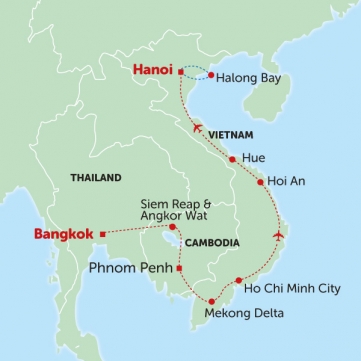
Duration: 34 Days Route: Bangkok to Hanoi Style: Adventure Tours Price: US$2,949.00
Laos, Thailand, Cambodia, Vietnam
A kaleidoscopic fusion of cultures, cuisines, landscapes and religions, the nations of Indochina offer a deliciously varied travel experience. From bustling Bangkok to the stunning temples of Laos, exploring the history of Thailand’s infamous Golden Triangle, Cambodia’s ancient wonder of Angkor Wat, to the local hospitality in the Mekong Delta to Vietnam’s coastline and Halong Bay for a cruise around stunning limestone islets set in turquoise waters.
The tour that we operate in the reverse direction is Complete Indochina (SECI).
Tour Dossier Introduction
- Dossier Last Updated: 10-04-2013
- Tour Code: SEIC
- Duration: 33 nights / 34 days
- Joining City: Bangkok
- Departure City: Hanoi
- Nearest Joining International Airport: Noi Bai International Airport Hanoi (HAN)
- Nearest Departing International Airport: Suvarnabhumi Intl Airport Bangkok (BKK)
This dossier is designed for this particular tour and should be read in conjunction with the country dossier(s), regional pre-departure booklet and optional excursions guides relevant to your itinerary. You will also receive a joining letter in advance of your journey with further information, while last minute updates may be posted in the Latest News section of our website.
Tour Documents
Inclusions
- Accommodation: 25 night(s) in hotel(s), hostel(s) & guesthouse(s), 3 night(s) on overnight train(s), 1 HS/H, 2 night(s) on overnight bus(es), 1 night(s) in homestay(s), 1 JUNK
- Meals: 13 breakfast(s), 4 lunch(es), 3 dinner(s)
- Excursions: Vang Vieng bicycle tour, Opium Museum, White Temple, Hilltribe Trek, Elephant Ride, Bamboo raft ride, Angkor Wat, Mekong Delta, Halong Bay Cruise
- Transport: Local public bus, train, boat, taxi, on foot
- Age: 18-60, max. 70 (recommended)
- Group: Average 8-12
- Staff: Tucan Travel tour leader, local guides
Exclusions
International flights and departure taxes
Domestic flight taxes if applicable
Tips on included excursions, visas, travel insurance, personal items and single rooms.
Airport transfers and pre and post tour accommodation
Spending money – budget for meals, snacks, drinks, limited souvenirs, laundry, tips and any extras
Optional excursions - Please see our optional excursions guide on the dossier page for a comprehensive list of optional activities and excursions available on this tour.
Highlights
-
Luang Prabang
-
Hill Tribe Trek
-
Bangkok Nightlife
-
Ho Chi Minh City
-
Mekong Delta
Detailed Itinerary
Day 1 to 1 - Arrive Bangkok
The first day of your tour is simply an arrival day with no pre-organised activities. In order to allow time to relax and see some of the sights you may wish to add pre tour accommodation. On arrival please ask at the reception for information on when the pre departure meeting will be held.
Thailand's capital, Bangkok, a crazy and chaotic city! Known in Thai as Krung Thep Maha Nakhon pronounced or Krung Thep "city of angels" for short, Bangkok was a small trading post at the mouth of the Chao Phraya River during the Ayutthaya Kingdom. Bangkok is now the gateway to South East Asia for most travellers and international backpackers come and go and the streets are always buzzing and full of life.
No visit to Bangkok is complete without a visit to Khao San Road, the famous strip filled with markets, stalls and neon lights. From people watching to shopping, and nightlife to food and drink, this is the place to be on a night out in Bangkok. If you're feeling adventurous you might wish to try a fried insect or two! As an alternative, the Patpong area is Bangkok's most notorious nightlife area. Exotic bars, clubs, neon lights, and night markets abound and you may be able to see some interesting stage shows if you so desire.
On a more cultural note, Bangkok also boasts hundreds of Wats (temples), with Wat Arun being the main one visited by most travellers. The Grand Palace is also a popular attraction, and for something different you can cruise along the Chao Phraya River and through the canals. Bangkok once had an elaborate network of canals and was given the nickname, 'Venice of the East', and although some of them have been filled in and converted to streets, many still exist today. Travelling through these canals you will see how the locals live along the riverside - you almost forget you are in a large, bustling city.
Day 2 to 5 - Vientiane – Vang Vieng
We have a final day in Bangkok before we board our overnight train to Nhong Khai on the border of Laos. On arrival we will jump in some local tuk tuks to get to the boarder crossing where, after the formalities, we will get a van to our base, Vientiane.
The capital of Laos is extremely quiet - so quiet that, before 1970, there was only one set of traffic lights in the entire city (a far cry from Bangkok!). We have time to admire this tranquil city with its many murals and markets. Many buildings you will see when you wander the streets are of religious significance. You may wish to hire a bicycle and explore the local streets and markets which are excellent here.
As we make our way north from Vientiane we travel through stunning scenery to Vang Vieng. This peaceful town is situated in a plateau with stunning surroundings of limestone caves and waterfalls, and the area is inhabited by the Hmong and Yao tribes. The limestone caves are renowned in ancient mythology and have featured in the prose of many artists throughout time. Vang Vieng is an excellent place to try the local cuisine and there are markets to indulge in. Feeling energised we will take a bicycle tour off the beaten track through some of Laos' most incredible scenery and view a wonderful sunset across lush paddy fields before arriving for a swim at the Blue Lagoon.
Day 6 to 9 - Luang Prabang – Pakbeng – Huay Xai
Many say this is the most memorable town in all of Laos. Renowned for a fascinating history and some of the friendliest people in South East Asia, Luang Prabang refers to the holy Pra Bang, Laos' most sacred image of the Buddha given to Fa Ngoum.
We have two days to enjoy this sleepy town, which is located 300 metres above sea level on the upper Mekong. As you explore you will see that Luang Prabang is dominated by Phousi - the marvellous hill-top temple that sits in the middle of the town. You'll notice a combination of Lao, French and Lao-French colonial influence as you admire the city's buildings and architectural highlights - all of which you can see discovering the town on foot.
There are many temples to visit in Luang Prabang - over 30 in fact, which is a large number for this small town. Along the way you may encounter some young monks eager to practice their English skills as well.
From Luang Prabang, we begin a two-leg journey that will take us towards northern Thailand entirely by boat along the mighty Mekong River. We stop overnight midway at the small riverside village of Pakbeng, where the pace of life really slows down and you can relax and enjoy a nice cold award-winning Beer Laos. The next day we are back on the river and continue our boat adventure to Houei Sai where the Mekong River is the only divide between Thailand and Laos. We stay in Houei Sai overnight and enjoy our last experience of Laos hospitality before crossing the river the next morning into northern Thailand and the infamous Golden Triangle.
Our journey today culminates in Chiang Mai but the destination is only a part of the experience. After crossing the Mekong River by longboat and clearing Thai customs at the roadside “customs hut” we continue in private, air-conditioned minivans to discover the Golden Triangle, the infamous centre of Asia's illicit opium production, where Laos, Thailand and Burma meet at a single point close to the Chinese border. Visit the old Opium Museum, the giant Golden Buddha sitting on a boat by the riverside and the stone elephants there to protect him.
Lunch will be taken at Wat Rong Khun, or White Temple, outside Chiang Rai. Many Tucan Tour leaders have claimed that Rong Khun is the most fascinating temple they have visited and during your visit you’ll be amazed at the decorations, which are in total contrast to the holy elements experienced in most Buddhist temples. An amazing day ends with our arrival into Chiang Mai, the 'Rose of the North', where you can enjoy a Thai cooking course, relaxing massage, take in a night-time Thai kick-boxing bout (Muay Thai) or haggle the night away at Chiang Mai’s famous evening street bizarre.
We will begin our included one-night/two-day excursion, which includes a hill tribe trek, elephant ride and bamboo raft ride. We will be picked up at the hotel in the morning then taken by a local guide in a private Songthaew, which is a converted pick-up truck that has seating at the back - the standard mode of transport for many in Thailand, to our first stop, which will be the tourist police station to get permission stamps before we transfer to the local market to explore and shop for tonight’s home-cooked dinner and if you like, buy bananas to treat your elephant on tomorrow’s trek.
We then drive to the beautiful caves of Chiang Dao, with its amazing limestone stalactites and stalagmites, and beautiful white marble Buddhist statues from Burma.
We stop near the caves for lunch and in the afternoon we continue by songthaew through light jungle to an Akha and Lisu village to experience a little of their traditional lifestyle. The terrain here is mountainous and offers magnificent views. From here we walk about one hour to a Palong village where you spend the night in a rustic homestay. Dinner will be cooked the traditional way by the local guide and you will be welcome to watch or give him a hand. In the evening you will have the option to enjoy a cultural dance performance by local Palong children (you will need to pay/tip the children).
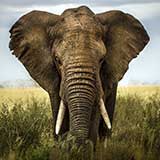
After breakfast the next day, the elephants will arrive for a gentle one hour trek. The elephants are 15-20 years old and are taken care of by the mahout (elephant driver). At the end of the ride we have a trek followed by a 4WD ride to the Ping River where our bamboo rafts await us. We will navigate down the river, perhaps seeing village women washing their clothes in the river as children play at the edge. After lunch we will stop on the way at a small market and visit an orchid nursery where you can admire some 200 different species of these beautiful flowers (depending on the season) before heading back to Chiang Mai in the late afternoon.
PLEASE NOTE: The route for the hilltribe trek is weather dependant so the above description may differ.
Day 10 to 14 - Chiang Mai – Hill Tribe Trek – Bangkok
Before we board our overnight bus back to Bangkok you will have some final free time to relax and enjoy Chiang Mai.
We are back in Bangkok in the early morning where we will spend another couple of free days in this great city. It's a chance to indulge in even more shopping and nightlife, or perhaps take it easy and visit some of the popular Wats in the area. A great market to visit, if not for the best bargain, but for its sheer size, is the 35 acre Chatuchak Weekend Market which has reached a landmark status as a must-visit place in Bangkok. Get there easily by skytrain to Mo Chit station.
Day 15 to 17 - Siem Reap
Siem Reap is our base for exploring the famous temples of the Angkor area. The name Siem Reap means 'Defeat of Siam' - today's Thailand - and refers to a century-old bloodbath which you can see commemorated in stone in the celebrated bas relief carvings of the monuments around the area.
Our first day we head out on our included excursion to the most famous temple, Angkor Wat, with a guide to give us an overview of the history and layout of the temple. Our remaining time in Siem Reap can be spent at our own leisure exploring this expansive site armed with our cameras and the knowledge from our guide.
There are over one thousand temples here which attract over one million visitors annually. The temples range from small ruins to the famous Angkor Wat, and the site is said to be the world's largest single religious monument.
Angkor Wat, a UNESCO World Heritage site, pays homage to the Hindu god Vishnu and has a dazzling array of beautiful ornate carvings. The many ceremonial structures and temples here were built between the 9th and 13th centuries by the Khmer Empire that spanned a period of approximately 600 years. These temples are some of the most famous in the world and take up an area of approximately 160 square kilometres.
There are superb photographic opportunities here at most times of the day so make sure your camera batteries are fully charged and your memory card is ready to go! Tuk-tuks provide a convenient form of transport around the area here, and you can hire a tuk-tuk and driver for the day if you wish. The Angkor area (in and around the Ta Prohm temple) was the site where the film Tomb Raider starring Angelina Jolie was filmed.
Day 18 to 19 - Phnom Penh
Phnom Penh is Cambodia's bustling capital city with a turbulent past. Located on the banks of the Mekong River, Phnom Penh has been the national capital since the French colonised Cambodia during the 19th century. The city has grown from a small fishing village to what is now the industrial, commercial, cultural and historical centre of Cambodia.
Take a visit to the Tuol Sleng Genocide Museum (a former torture centre) and the Choueng Ek Memorial at the site of the Killing Fields, to learn about one aspect of this country's turbulent past.
Phnom Penh has many other attractions including the Russian Market and National Museum. You could also take a stroll along the river's famous Sisowath Quay and enjoy a coffee or cocktail at one of the many cafes while observing the bustling river traffic. You may wish to take a tuk-tuk ride around Phnom Penh (a tuk-tuk is a motorbike-taxi with an enclosed passenger cabin that can fit around 4 people).
Day 20 to 25 - Ho Chi Minh City – Mekong Delta – Nha Trang
Ho Chi Minh City was known as Saigon until the end of the Vietnam War (around 1975), originally a small fishing village, Ho Chi Minh City is now the most important economic centre in Vietnam and is the largest city in the country.
Traffic in the city is fairly hectic at the best of times but getting around is suprisingly easy by taxi or motorbike taxi, although drivers may not always speak English. Bus is the only form of public transport and motorbikes rule the road; there are around 3 million motorbikes cruising around the streets of Ho Chi Minh City.
If you're interested in the history of the Vietnam War make sure you visit the War Remnants Museum and the Reunification Hall. If you're less of a history buff and more in the mood to haggle for a bargain, don't miss Ho Chi Minh's largest market, the Ben Thanh Market. You can buy everything from cosmetics to live ducks here. There are also numerous food stalls at this market, and at the popular night market nearby. The food in Ho Chi Minh is some of the best and most diverse in all of Vietnam so make sure you eat well during your stay. There are also many bars and clubs to spend your evening in.
This morning we travel to the heart of the Mekong Delta, a region in south-western Vietnam where the Mekong River approaches and empties into the sea through a network of distributaries. Life in the Mekong Delta revolves much around the river, and many of the villages are often accessible by rivers and canals rather than by road. The region produces half of the country's rice output which is more than Japan and Korea together.
On our way out, if timing allows, we will visit Cao Dai temple. Cao Dai is a syncretist Vietnamese religious movement that incorporates aspect of Buddhism, Taoism, Confucianism and even Catholicism. The Temple was begun in 1933 in a unique architectural style that reflects its blended traditions.
We will take a boat trip around the tributaries of the mighty Mekong River which provides an insight into a real perspective of Delta life. We will also visit some local businesses from a floating market, rice paper and sweet making place, ceramics factory and tile making shop, rice processing plant, bonsai garden where you can hold a giant snake, taste local fruits, drink tea or snake wine. It is a great opportunity to purchase some unique souvenirs to support the local community. We will stay with a local family overnight. We will be staying in home stays along with other members of your group. The accommodation on the Mekong Delta takes us back to basics and has no showers and no hot water.
The next morning we take an early cruise on a traditional sampan to visit the famous floating markets before we head to Nha Trang in the afternoon.
Nha Trang is a popular beachside destination for many travellers and is brimming with restaurants, bars and nightlife. You can choose to relax and swim in the surrounding crystal clear waters - try your hand at kite surfing, scuba diving or maybe hit the seas on a catamaran. To really chill out on the seas you could maybe take a cruise around the islands with a seafood lunch.
Day 26 to 29 - Nha Trang – Danang – Hoi An – Hue
We have a final day in Nha Trang before boarding our overnight bus to Danang. From Danang we make our way to Hoi An where we have free time to explore the handicrafts, ceramics and fabrics that are sold at an abundance of markets. Hoi An is renowned for tailoring; pack your favourite item of clothing and get it copied here! If you're all shopped-out, you might enjoy relaxing on the serene coastal beaches with some local cuisine.
We depart Hoi An and travel north to Hue. The drive takes us across the Marble Mountains and via the scenic Hai van Pass. There are stunning views to take in of the surrounding coastline and rice paddies.
Once the capital of Vietnam (during the Nguen Dynasty in 1802-1945), Hue is situated on the banks of the Huong Giang or Perfume River. It is a UNESCO World Heritage Site and a bustling, lively place with many things to see and do. Hue is renowned for its monuments temples, pagodas and architecture. The Imperial City, often likened to the Forbidden City in Beijing (and sometimes referred to as the Forbidden City as well), is well worth a visit. Hue also offers many Buddhist pagodas and markets to explore if you just feel like soaking up the lively atmosphere.
Day 30 to 33 - Hue – Halong Bay – Hanoi
We leave Hue by overnight train to Hanoi where we will make our way directly to Halong Bay. The area is surrounded by spectacular beaches and is, naturally, renowned for its delicious seafood! We will arrive around midday and we will board a junk boat for our overnight cruise. The cruise will visit the famous caves and then find a secluded spot for swimming, kayaking and sunbaking.
Halong Bay (Bay of Descending Dragons) is renowned for its limestone karsts. The bay consists of a dense cluster of just under 2000 limestone monolithic islands, each topped with thick jungle vegetation, which rise dramatically from the ocean. Several of these islands are hollow and contain large caves, and on our cruise we will be able to explore these caves filled with stalactites and stalagmites. Dinner will be followed by the option of a spot of night fishing if you're still awake!
Local legend describing the origin of the bay claims that the gods sent a family of dragons to defend the land when locals were fighting neighbouring invaders (thus the name 'Bay of Descending Dragons'). When the dragons came down on Halong Bay they began spitting out jewels, which turned into the various islands that are scattered around the bay, linking together and forming a barrier against invaders. Halong Bay was kept safe and free from invading warriors from then on.
In the morning we will continue to cruise around the bay to find more secluded areas to swim in or you may like to hire a kayak for some energetic exploring. In the early afternoon we will depart the majestic Halong Bay and travel back to Hanoi for some more free time. If you haven't seen a water puppet show yet, make it your business to do so at our stop this time as it is our last visit to Hanoi.
Hanoi is the capital of the Socialist Republic and is dominated by colonial buildings and tree-lined boulevards. The city boasts a convoluted yet elegant history which is characterised by its 'chameleon of names' - the city has changed names many times throughout history. In terms of recent history, the French withdrew their forces in 1954 and ever since foreign investment and property has developed substantially.
In Hanoi, exploring on your own is relatively easy on foot or by bike. Many travellers believe the true appeal and essence of Hanoi is discovered wandering the streets, tasting local market food, observing the local way of life, and taking in the architecture and surroundings.
Day 34 to 34 - Depart Hanoi
Your adventure of a lifetime comes to an end today. If you have a late flight or have lengthened your stay by adding post tour accommodation you will have more time to explore the sights.
The itinerary listed above is to be used as a guide only. Occasionally we may need to update this document and it may be different to the information printed in our current brochure. Tour leaders may need to make adjustments due to unforeseen circumstances during the tour. It is very important that you visit our website and review a copy of this dossier as close as possible to your departure date in case of changes that may affect your plans. Any last minute changes may also be posted in the latest news section of our website.
Group Size
This tour has a maximum of 16 with an average of 8-12 travellers.
Other Services – pre & post tour accommodation and airport transfers
Very little time is spent in each of the starting and finishing cities and you will need to allow a few days at the beginning or end of your tour if you want to explore them further. Airport transfers in joining and departing cities are not included in the tour price but can be booked through Tucan Travel at an additional cost. For details about how to book pre & post accommodation please refer to the Extra Services information page in our website. Price information can be found on the price page of each tour. If you would prefer to make your own way to and from your hotel, you can find further details on the joining letter for this tour.
Single Supplements
This package may offer single supplements that enable clients to stay in a single room. This single supplement must be paid prior to departure and applies to the whole tour for nights where single rooms can be made available. If there is no offer for a single room this is usually because you will be on an overnight train or bus, or camping.
In the day-by-day grid below a ✔ will indicate in which destinations single rooms are available to those who have purchased a single supplement.
Day by Day Itinerary
| Day | Activity | Country | Meals | Single Room |
| Day 1 | Bangkok | Thailand | ✓ | |
| Day 2 | Overnight train to Vientiane | |||
| Day 3 | Vientiane | Laos | ✓ | |
| Day 4 | Vang Vieng | B | ✓ | |
| Day 5 | Vang Vieng | ✓ | ||
| Day 6 | Luang Prabang | ✓ | ||
| Day 7 | Luang Prabang | ✓ | ||
| Day 8 | Pakbeng | ✓ | ||
| Day 9 | Huay Xai | B | ✓ | |
| Day 10 | Chiang Mai | Thailand | ✓ | |
| Day 11 | Hill Tribe Trek or Chiang Mai | LD | ||
| Day 12 | Overnight bus to Bangkok | BL | ||
| Day 13 | Bangkok | ✓ | ||
| Day 14 | Bangkok | ✓ | ||
| Day 15 | Siem Reap | Cambodia | ✓ | |
| Day 16 | Siem Reap | ✓ | ||
| Day 17 | Siem Reap | ✓ | ||
| Day 18 | Phnom Penh | ✓ | ||
| Day 19 | Phnom Penh | ✓ | ||
| Day 20 | Ho Chi Minh City | Vietnam | ✓ | |
| Day 21 | Ho Chi Minh City | B | ✓ | |
| Day 22 | Mekong Delta | BD | ||
| Day 23 | Overnight train to Nha Trang | B | ||
| Day 24 | Nha Trang | ✓ | ||
| Day 25 | Nha Trang | B | ✓ | |
| Day 26 | Overnight bus to Hoi An | B | ||
| Day 27 | Hoi An | ✓ | ||
| Day 28 | Hoi An | B | ✓ | |
| Day 29 | Hue | B | ✓ | |
| Day 30 | Overnight train to Hanoi | |||
| Day 31 | Halong Bay | LD | ||
| Day 32 | Hanoi | BL | ✓ | |
| Day 33 | Hanoi | B | ✓ | |
| Day 34 | Hanoi | B |
(B - Breakfast, L - Lunch, D - Dinner included)
Please note the day to day itinerary above is given as a GUIDELINE ONLY.