Enquire About This Tour Code PDL Peaks to Desert

Duration: 26 Days Route: Lima to Santiago Style: Adventure Tours Price: US$3,299.00

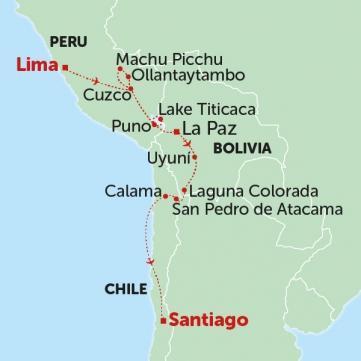
Peru, Bolivia, Chile

From the high Andes to the world's driest desert, this trip is a different experience every day. You'll discover the ancient Inca Empire, visit the Amazon jungle, stay overnight on Lake Titicaca, drive across Bolivia's great salt lake and travel down the Pacific coast of Chile to Santiago.

The tour that we operate in the reverse direction is Peaks to Desert (PDS).


Tour Dossier Introduction

  • Dossier Last Updated: 10-04-2013
  • Tour Code: PDL
  • Duration: 25 nights / 26 days
  • Joining City: Lima
  • Departure City: Santiago
  • Nearest Joining International Airport: Jorge Chavez International Airport Lima (LIM)
  • Nearest Departing International Airport: A Merino Benitez Intl Airport Santiago (SCL)

This dossier is designed for this particular tour and should be read in conjunction with the country dossier(s), regional pre-departure booklet and optional excursions guides relevant to your itinerary. You will also receive a joining letter in advance of your journey with further information, while last minute updates may be posted in the Latest News section of our website.

Inclusions

  • Accommodation: 21 night(s) in hotel(s), hostel(s) & guesthouse(s), 2 night(s) in a Jungle Lodge, 1 night(s) in homestay(s), 1 night(s) on overnight bus(es)
  • Meals: 5 breakfast(s), 6 lunch(es), 5 dinner(s)
  • Excursions: Machu Picchu, Sacred Valley, Amazon Jungle, Lake Titicaca, Salar de Uyuní, Laguna Colorada, Valley of the Moon
  • Transport: Local public bus, boat, taxi, on foot, 4WD, 3 flight(s)
  • Age: 18-60, max. 70 (recommended)
  • Group: Average 8-12
  • Staff: Tucan Travel tour leader, local guides

Exclusions

  • International flights and departure taxes

  • Domestic flight taxes if applicable

  • Tips on included excursions, visas, travel insurance, personal items and single rooms.

  • Airport transfers and pre and post tour accommodation

  • Spending money – budget for meals, snacks, drinks, limited souvenirs, laundry, tips and any extras

  • Optional excursions - Please see our optional excursions guide on the dossier page for a comprehensive list of optional activities and excursions available on this tour.

Highlights

Detailed Itinerary

Day 1 to 1 - Arrive Lima

The first day of your tour is simply an arrival day with no pre-organised activities. In order to allow time to relax and see some of the sights you may wish to add pre tour accommodation. On arrival please ask at the reception for information on when the pre departure meeting will be held.

Lima was founded by the Spanish Conquistador Francisco Pizarro in 1535 after he eradicated the Incas and made the city his capital. Lima has many fine colonial buildings and some of the best museums in South America including the Gold Museum, Museum of the Inquisition and the Catacombs below the San Francisco Church. Peru's capital has much to offer and many of the sights, including the city's two main squares the Plaza de Armas and Plaza San Martin, are within easy walking distance The Plaza de Armas houses the Cathedral, Municipal Palace and Presidential Palace where the changing of the guard can be seen every day at 12 noon. There are also many markets in Lima, possibly the best being in the central district.

Day 2 to 7 - Cuzco – Amazon Jungle – Cuzco

Our Tucan Travel rep will transfer you to Lima airport from where you'll take a 60 minute flight up into the high Andes over spectacular scenery to the former Inca capital of Cuzco, which means ‘navel of the earth' in the Inca language of Quechua. This enchanting city has a mostly indigenous population of around 300,000 people, and you will be taken on an orientation walk of the city.

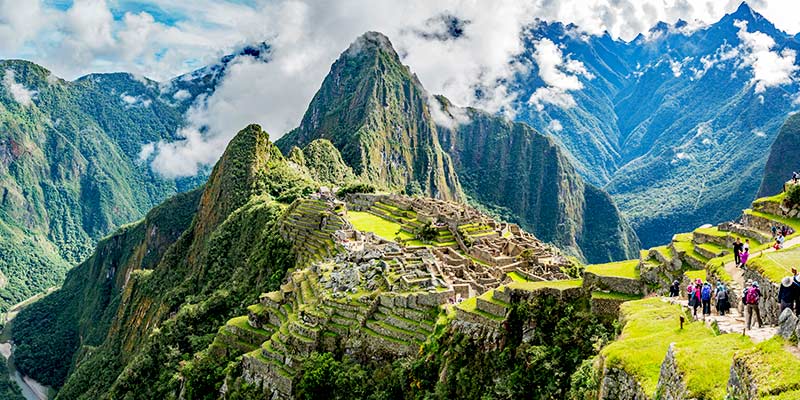
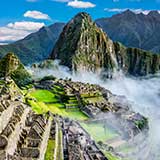
The lost city of Machu Picchu (Old Mountain) was originally completely self -contained, surrounded by agricultural terraces sufficient to feed the population, and watered by natural springs. Located high above the fast flowing Urubamba River, the cloud shrouded ruins have palaces, baths, temples, storage rooms and some 150 houses, all in a remarkable state of preservation that will simply take your breath away. The ruins were only discovered by the outside world in 1911, when American explorer Hiram Bingham found them while looking for another “lost city” called Vilcabamba. Due to their isolation many of the buildings are still quite intact and you can't help but admire Huayna Picchu (Young Mountain), which towers above the ruins. It is a hard climb to the top of the mountain (it takes about 50 minutes) but you are rewarded with spectacular views over the whole site.

A full day is spent visiting the Sacred Valley of the Incas. Firstly we visit the Pisac ruins, perched on a hilltop with incredible views of the snow -capped mountains. We then go down to the famous traditional market of the same name, which is full of colour and atmosphere. A great place for souvenirs! After lunch, we continue along the valley to the temple/fortress of Ollantaytambo with its enormous Inca terracing constructed on the side of a steep mountain.

Our Tucan Travel rep will transfer you to the airport for your flight to the jungle community of Puerto Maldonado, the starting point for our visit to the Amazon rainforest.

In Puerto Maldonado you can pick up any last minute drinks or snacks in the busy markets and shops. The first leg of our journey is by bus followed by motorised canoe, a 35 kilometre journey along the river (approx two hours total). The canoes are very safe and lifejackets are supplied.

Arriving at the lodge located on the river’s edge, you will be allocated a bungalow all of which are built from local indigenous materials. Each room is sealed by meshed netting to keep out mosquitoes and other insects. All rooms have basic private bathroom facilities. Due to the remoteness of the lodge there is no hot water and drinking water should be purchased. There is also limited electricity so please charge any electrical equipment prior to your arrival. In the evening the lodge and walkways are lit by oil lamps. Other facilities include a welcoming reception area, dining room and bar facilities. All excursions are led by English speaking local guides providing plenty of opportunity to enjoy marvelous jungle landscapes and rich diversity of flora and fauna.

After lunch we take a short boat trip across the Madre de Dios River to Monkey Island. On the way over you may spot caiman from the boat. Once on the island it is possible to see a great variety of monkeys such as the ‘maquisapa’, black and white ‘Martins’, ‘Leoncito de la Selva’ (Little Lions), ‘Frailes’ (Friars), ‘Achuñis’, ‘Ronsocos’ as well as an array of birdlife. In the evenings it is often possible to enjoy the wonderful sunset, one of the most impressive sights of the forest (weather permitting). We then return to the lodge for dinner.

After an early breakfast we will set off on a trek through the rainforest along wooden walk ways. On the way our guide will stop to show you various species of bird and explain the medicinal plants and delicate ecological systems of the Amazon Jungle. The scenery is extremely varied incorporating dense jungle as well as marsh areas. You will see incredibly big trees, several metres in diameter and around 450 years old. There is an opportunity to take a canoe ride drifting along one of the small lakes hidden away in the jungle, observing caiman and the abundant bird life. We may also catch a glimpse of the rare giant otter.

Afterwards we will enjoy the view of the lake from our viewing point/observation platform, where you can experience the canopy wildlife such as parrots, guacamayos, toucans, camungos, shanshos, herons, turtles and caiman. We will return to the lodge for a well deserved lunch. In the afternoon we visit the Gamitana River where you can try fishing or take a dip. (All excursions are weather permitting and itineraries may be changed slightly due to local conditions).

On the final day we awake to the sounds of the jungle before departing this jungle haven and returning to Puerto Maldonado for our flight on to Cuzco, where you have the rest of the day free to explore this fascinating ancient capital.

Day 8 to 13 - Puno – Lake Titicaca – Puno – La Paz

Leaving Cuzco, we'll drive along roads abundant with herds of llamas, alpacas and vicuñas before reaching the Altiplano (high plain) where our journey takes us past hot mineral pools, snow capped mountains and through villages where the locals sell food, fur hats and alpaca sweaters. At the highest point, the La Raya pass at 4,321 metres, you can see the research station for high altitude animals.

The beautiful scenery is continual all the way to Puno on the shores of Lake Titicaca, which at 3,855 metres above sea level, is the highest navigable lake in the world. We'll arrive in time so you can visit the colourful local market.

The next morning departing Puno for our overnight excursion we visit the floating reed islands in the Bay of Puno to see the Uros islanders way of life and we will have the option to ride in a traditional reed boat before continuing our boat journey to the island of Amantaní. Here we enjoy the hospitality of the local Aymara/Quechua families sleeping in their homes. We recommend you to purchase gifts for the families at the port of Puno before leaving to offer to the families – they will greatly appreciate this gesture. The next morning we visit Taquile Island, where the men stand around knitting distinctive woollen hats while the women work the fields. You can buy some of these unique handicrafts in the local cooperative shops. After lunch we board our boat for the return journey to Puno.

We travel around Lake Titicaca as we make our way towards Bolivia. After crossing the border, we continue to travel across the scenic Altiplano (high plateau) following the shores of Lake Titicaca. As we continue our journey we have breathtaking views of the surrounding mountains as the road winds its way into La Paz, the highest capital city in the world at 3,636 metres.

Built on a series of hills and considered one of the world's most beautiful cities, La Paz was established in the basin of a canyon with the snow -capped Mount Illimani in the background. Our hotel is very centrally located and is just around the corner from the city's colourful indigenous street markets including the fascinating and suitably named "witches market'' where bowler hat wearing women in their flared skirts sell such items as dead cats and llamas foetuses said to ward off evil spirits. The main square, Plaza Murillo, is also within walking distance. The square still retains its colonial buildings including the Presidential Palace. La Paz is possibly the best place to experience a traditional peña show of Andean music and dance where local bands play time -honoured instruments such as zampoñas (pipes) and charangos (ukulele).

There are also many optional excursions available. You might like to visit the Moon Valley with its strange rock formations shaped by the weather or take in the incredible views from Mount Chacaltaya and the world's highest ski resort at 5,221 metres. Another fantastic excursion is to the emerald green area of Coroico, the gateway to the Bolivian jungle region and a great place to see sub -tropical vegetation and plants. En route you will cross a 5,000 metre high pass before descending to 1,300 metres on narrow mountain roads bordered by sheer drops. The excursion to Coroico can also be done by mountain bike, as it is downhill nearly all the way and very exhilarating, but not for the fainthearted!

Day 14 to 18 - Potosí – Uyuní – Laguna Colorada

Travelling further into Bolivia we come to the mining town of Potosí. The city was established by the Spanish in 1545 soon after the discovery of a rich vein of silver in a nearby hill, the Cerro Rico (Rich Hill) It soon became the world's largest silver producer and silver from Potosí underwrote the Spanish economy, particularly the monarchy's extravagance, for over two centuries. Millions of indigenous South Americans, and later, African slaves, worked in the mines in appalling conditions. You have the option to visit the mines, stopping first at the miners market to buy gifts such as coca leaves, dynamite and cigarettes. In the mines we will experience the difficult conditions in which the miners work – including 50°C heat. We'll pass several of the shrines they have made to the “Tios” which they hope will protect them while they are working in what they believe is the devil's territory.

If you'd like to learn more of the historic silver industry you can take a tour of the Moneda, a museum exhibiting coins, artwork, mummies and many other interesting artefacts from Potosí's history.

Moving on we reach the desolate town of Uyuní in the south of Bolivia. From here we visit what is claimed to be the largest salt flat in the world, the brilliant white vast Salar de Uyuní. Travelling by 4WD vehicles we will spend the day exploring the salt lake and surrounds. First on the agenda is a visit to the Train Cemetery, where you can see the remains of 19th and early 20th century steam locomotives - a good place for artistic photographs. We will then come to Colchani, the main plant for the iodisation of salt and the best place to observe the methods of salt extraction from the salar. Here ovens are used to dry the salt, which is then formed into cakes. The highlight of the day is Fish Island. Located in the centre of the salar, 100 kilometres from Uyuní, this hilly outpost is covered in giant cacti amid a flat, white sea of hexagonal salt tiles. The island is so named because it has the shape of a fish. Visiting Fish Island is quite otherworldly and the fantastic contrast of the brilliant blue sky (weather permitting of course) and the pure white of the salt flats will take your breath away. In the afternoon we shall continue to San Juan where we spend the night.

Following breakfast we head for the Red Lagoon (Laguna Colorada). We pass through the Siloli Desert where we encounter spectacular landscapes with multicoloured volcanic rock formations and stop at other lagoons en route. Covering an area of 60 square kilometres, the lagoon has a rich red colouration derived from algae and plankton which thrive in its minerals. The shoreline is fringed with brilliant white deposits of sodium, magnesium, borax and gypsum and the lagoon is inhabited by numerous flamingos, three unique species of which breed there.

Please Note: Occasionally in the rainy season the salt flats become overly flooded and we may have to alter the itinerary if the salt flats are not safe to traverse.

Day 19 to 21 - San Pedro de Atacama

Leaving Laguna Colorada we visit the volcanic zone ‘Sol de Mañana' (Morning Sun) at 4,850 metres above sea level. Here you'll discover a geyser basin with bubbling mud pots, hellish fumaroles and a thick aroma of sulphur fumes. Inside a small crater we will observe boiling lava and we will also stop at hot springs where you can bathe. Crossing a 5,000 metre pass we come to Laguna Verde (Green Lagoon) rich in lead, sulphur and calcium carbonate and shadowed by the cone of the Licancabur Volcano. Continuing on we will cross into Chile and come to San Pedro de Atacama in the world's driest desert. The area is famous for its lunar landscapes, geysers, salt flats and hot springs. There is an excellent archaeological museum at San Pedro de Atacama, housing a good selection of mummies and other ancient artefacts. Here we have the included visit to the eerie eroded salt mountains of the Valley of the Moon.

Day 22 to 25 - La Serena – Santiago

We catch an overnight bus to La Serena, a pleasant little coastal town and important astronomical centre. Here you can laze around on the long beach, visit the interesting town or stroll to neighbouring Coquimbo along the bay. There are also optional excursions to the Elqui Valley the home of Chilean Pisco and also an optional excursion to one of the many Observatories to get a bird’s eye view of the night sky.

Entering the fertile region of the Chilean heartlands we pass farmlands and vineyards on the way to our final stop, the European-style capital Santiago.

Day 26 to 26 - Depart Santiago

Pedro de Valdivia established the city in 1541 but not much remains of its original glory. At Santa Lucia Hill where the original fortress was constructed, there are excellent views of the city below. However, for even better photo opportunities, take a funicular railway to the top of San Cristobal where the Statue of the Virgin overlooks the capital and the distant Andes. At this very pleasant viewing area you'll find wine -tasting facilities and a couple of beautifully situated swimming pools. Santiago is a very clean modern city with fountains, parks and imposing buildings. In the Plaza Constitución at the Palacio de la Moneda you can see the changing of the guard on most days or you can take an optional excursion to the port of Valparaiso and the resort of Viña del Mar.

Your adventure of a lifetime comes to an end today, please confirm with the reception the check out time. If you have a late flight or have lengthened your stay by adding post tour accommodation you will have more time to explore the sights.

The itinerary listed above is to be used as a guide only. Occasionally we may need to update this document and it may be different to the information printed in our current brochure. Tour leaders may need to make adjustments due to unforeseen circumstances during the tour. It is very important that you visit our website and review a copy of this dossier as close as possible to your departure date in case of changes that may affect your plans. Any last minute changes may also be posted in the latest news section of our website.

Group Size

This tour has a maximum of 16 with an average of 8-12 travellers.

Other Services – pre & post tour accommodation and airport transfers

Very little time is spent in each of the starting and finishing cities and you will need to allow a few days at the beginning or end of your tour if you want to explore them further. Airport transfers in joining and departing cities are not included in the tour price but can be booked through Tucan Travel at an additional cost. For details about how to book pre & post accommodation please refer to the Extra Services information page in our website. Price information can be found on the price page of each tour. If you would prefer to make your own way to and from your hotel, you can find further details on the joining letter for this tour.

Single Supplements

This package may offer single supplements that enable clients to stay in a single room. This single supplement must be paid prior to departure and applies to the whole tour for nights where single rooms can be made available. If there is no offer for a single room this is usually because you will be on an overnight train or bus, or camping.

In the day-by-day grid below a  will indicate in which destinations single rooms are available to those who have purchased a single supplement.

Day by Day Itinerary

Day Activity Country Meals Single Room
Day 1 Lima Peru
Day 2 Cusco
Day 3 Cuzco
Day 4 Cuzco
Day 5 Cuzco/Jungle LD
Day 6 Cuzco/Jungle BLD
Day 7 Cuzco B
Day 8 Puno
Day 9 Lake Titicaca LD
Day 10 Puno B
Day 11 La Paz Bolivia
Day 12 La Paz
Day 13 La Paz
Day 14 Potosí
Day 15 Potosí
Day 16 Uyuní
Day 17 Salar de Uyuní LD
Day 18 Laguna Colorada BLD
Day 19 San Pedro de Atacama Chile BL
Day 20 San Pedro de Atacama
Day 21 San Pedro de Atacama
Day 22 Overnight Bus to La Serena
Day 23 La Serena
Day 24 La Serena
Day 25 Santiago
Day 26 Santiago

(B - Breakfast, L - Lunch, D - Dinner included)

Please note the day to day itinerary above is given as a GUIDELINE ONLY.


Get Involved

Follow Me on Pinterest Twitter Facebook Google+ You Tube Meet Up

Online Blogs

The Chasqui

Read our Blog Archive

Newsletter Signup

Title
First name
Surname
Country


Login